 |
Headed back to the mines, a load of empty ore cars passes below McKennon Arch as twilight comes to the desert. A raven croaks atop his favorite saguaro while a sleepy diamondback rattlesnake soaks up the last of the day's warmth held in the rocks. Though intent on his business, the gruff old engineer steals a moment to take in the view from the open cab of engine #6. With a contented sigh, he understands why some folks call this piece of country the Rainbow Desert.
|

Showing posts with label Living Desert. Show all posts
Showing posts with label Living Desert. Show all posts
Wednesday, January 21, 2015
The Rainbow Desert

Friday, January 9, 2015
Building a Better Cactus
 |
Down by McKennon Arch, a pair of cactus wrens are building their nest high in an old saguaro. These giant cactus can stand for centuries and provide homes for many desert creatures. The holes are made by gila woodpeckers and later get used as nesting spots by wrens and other birds. The birds are made from polymer clay and the saguaro cacti are carved and painted Balsa Foam. |
I must admit that I'm cheating a little by including a forest of giant saguaro cacti on my canyon country themed layout. In nature, saguaros are usually found down in the lower country of the Sonoran Desert and not up on the high plateaus around Four Corners. I've always had a soft spot for these bristly sentinels of the desert, so I hope I'll be forgiven for including a patch of them growing here or there. Also, the Cactus Forest was a feature of the Living Desert on Disneyland's original Nature's Wonderland Mine Train, and Thunder Mesa draws a lot of inspiration from that old attraction. And nothing says "Wild West" quite like the sight of mighty saguaro on the landscape.
Saguaro have been part of Thunder Mesa from the very beginning, but I've changed the way I model them over time. Originally, the Cactus Forest was populated with carved balsa wood succulents made with the old John Olson method, alongside some plastic monstrosities from Woodland Scenics. After a while, these no longer satisfied me and I began looking around for a better way to model them.
 |
The Cactus Forest as originally modeled with John Olson style balsa wood saguaros and some funny looking little plastic things from Woodland Scenics. |
I tried Travis Handschug's method of making saguaros from polymer clay but since I enjoy carving more than sculpting I finally ended up making most of my cactus from Balsa Foam, the same polyurethane carving foam that Thunder Mesa's rock formations are carved from. I use the higher density Balsa Foam II for cacti since it is less fragile and holds detail better than the softer foam. With a razor saw, I cut the foam into rods that are 1/2" square and about 6 or 7 inches long. Then they are sanded into a basic cigar-type shape before lines are scribed in with a hobby knife. Naturally, the crooked and bent arms are shaped from angled pieces of foam.
 |
Balsa Foam from American Art Clay Co., and some of the tools used to work with it. |
 |
Here's a craved Balsa Foam saguaro before painting. Along with some strong adhesive, small lengths of wire help hold the arms in place. The pointy end of a bamboo skewer is inserted into the base to serve as a handle during painting and to help plant the cactus on the layout. |
Now, everyone thinks they know what these cactus look like from movies and TV shows but it is very instructive to do some actual research into these plants. First of all, they grow a lot bigger than many people realize and a mature saguaro can tower 40' or more. That would be 10" tall in O scale! They can also have as many as 25 arms. It would take some real time and dedication to model a cactus like that.
 |
Real saguaros are big! |
Obviously, if I modeled them to scale they would dwarf everything else on the layout and throw off the carefully constructed false perspective illusion created by the buttes above. The only choice then was to caricature the saguaro. My cactus are at a smaller scale than the real thing (who knows? maybe they are a rare, "dwarf" subspecies that only grows at higher elevations), and they have just enough arms to get the idea across.
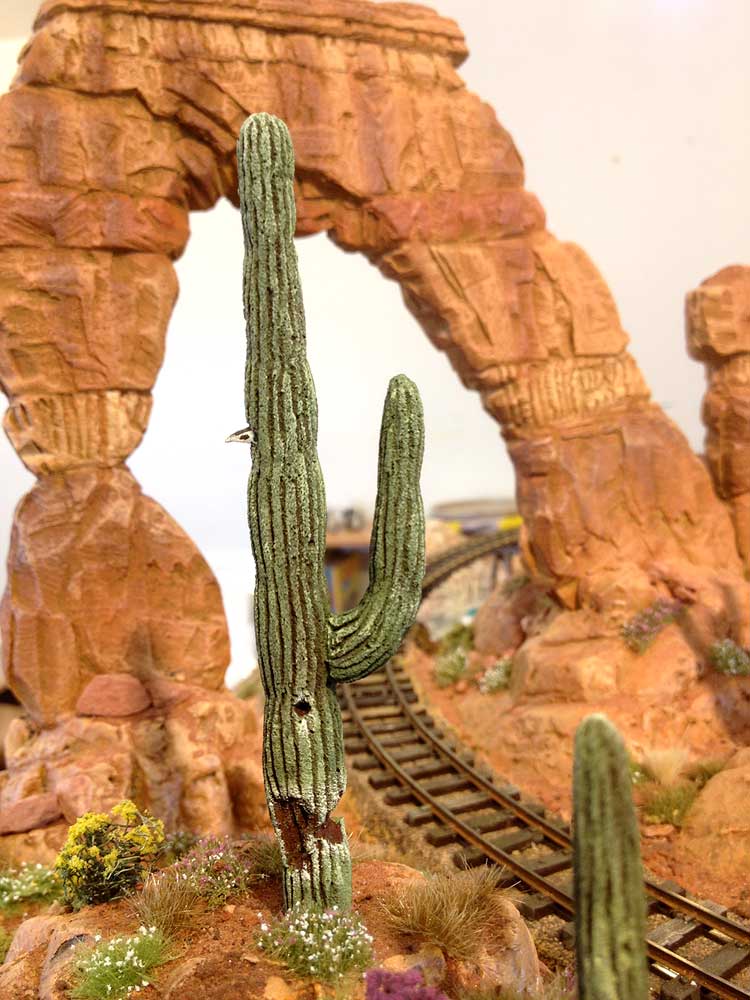 |
Another cactus wren pokes her head out of a finished saguaro. After carving, the cactus are painted with dark brown acrylic craft paint. Once that dries, Olive Green, Moss Green and Ivory are dry-brushed on to complete the paint job. The chewed away part of the cactus down below is evidence of javelina in the area. Javelina are bristly pig-like critters that enjoy chowing down on cactus. |
 |
The Cactus Forest today, sans backdrop. I'm much happier with the way it looks now and will be using the same techniques to add a few more saguaro here and there on the layout as things progress. |
That's the story of building a better cactus. Admittedly, today's post was more of a "what I did" than a "how to do it" and if I glossed over any details or if anyone has any questions, please feel free to ask in the comments section below. I've got several big new projects on the back burner and I look forward to sharing all of those as the new year goes on. As always, thanks for checking in, amigos. Adios for now!
Saturday, April 13, 2013
Thunder Mesa Inspirations #1: Disneyland's Mine Train Thru Nature's Wonderland
 |
Classic Disneyland attraction poster for the Mine Train Thru Nature's Wonderland.© Disney. |
A True Life Adventure
The original Rainbow Caverns Mine Train opened at Disneyland on July 2, 1957. Like Adventureland's Jungle River Cruise, the Mine Train played off of Walt Disney's popular True Life Adventure series of nature films. One film in particular, The Living Desert, was a major source of inspiration.
 |
Walt Disney Productions poster for the 1953 nature film The Living Desert. © Disney |
Plussing the Show
 |
This wonderful artwork was used to introduce the updated attraction to guests before it reopened in 1960. © Disney. |
A little less than three years after the Rainbow Caverns Mine Train opened, it was almost completely redone in a major upgrade and expansion. Nearly 2 million dollars were spent "plussing" and expanding the ride with over 200 Audio-Animatronic animals, a longer track plan and several dramatic new scenes. The original, 30" gauge, steam-outline battery operated locomotives and their trains were repainted a bright yellow, replacing an earlier dark green scheme, and the entire attraction was relaunched as the Mine Train Thru Nature's Wonderland in June of 1960.
 |
This great vintage look poster was used to announce the opening of Nature's Wonderland in 1960. © Disney. |
 |
Elevation drawing for Cascade Peak, one of the new "natural" wonders in Nature's Wonderland. © Disney. |
 |
WED Enterprises (WDI) elevation drawing for the Disneyland Mine Train. The 30" gauge trains were battery operated, each pulling seven cars with a maximum capacity of 74 guests per trip. © Disney. |
A dream team of first generation Imagineers was assembled to bring the project to life. Roger Broggie, Sam McKim, Bob Sewell, Bill Martin, Bob Mattey, Wathel Rogers and Vic Greene joined Claude Coats, creator of the amazing colored water effects in Rainbow Caverns, to design, engineer and build Walt's natural wonderland. The final result was like a trip through America's great National Parks, served up with a generous salting of Disney humor and whimsy. A new, recorded narration was provided by character actor and Disney favorite Dallas McKennon, describing the amazing sites along the way and adding a charming, rustic touch to the ride. The Living Desert and Rainbow Caverns were still there, but the expanded track loop now included the sites of Beaver Valley, Cascade Peak and Bear Country; all inspired by the True Life Adventure series of films.
Let's take a ride now on the Mine Train Thru Nature's Wonderland, just as it was back in the mid 1960s.
Have Your "E" Ticket Ready
Across Zocola Park from the Pepsi Cola Golden Horseshoe Revue, and just west of Casa de Fritos is the little mining town of Rainbow Ridge. Please remove an "E" coupon from your ticket book and hand it to the cheerful cast member as you prepare to board one of the bright yellow trains that has just emerged from the tunnel. Taking your seat in one of the ore cars, you hear the distinctive voice of Dal McKennon coming through the speakers...
Rainbow Ridge


Howdy folks! Welcome to the little minin' town of Rainbow Ridge, gateway to Nature's Wonderland. Please stay seated at all times, and keep your hands and arms inside the train. The animals get mighty hungry!The train begins to glide forward and the quaint little mining town is left behind as you pass through a dark tunnel...
Beaver Valley

Our first outpost is Beaver Valley, where many animals come to enjoy the plush resort atmosphere built up by nature's own engineer... the industrious beaver. Up ahead, those marmots keep playing tag over the tunnel entrance...
Cascade Peak

It sometimes gets pretty wet up ahead, folks. The rushing waterfalls crossing the tracks come from Cascade Peak to your right, the highest point in Frontierland. Don't worry though, everything will be okay, unless the wind changes... then we could all get a shower!
Bear Country

Now folks, I don't wanna scare you on this old rickety trestle, but everybody sit real still.. no tellin' how long she's gonna last!

We're comin' into Bear Country now, folks... Yuh know bears are one of the most playful animals there is. Lazy too. All they want to do is lay around 'n scratch, 'n fish, 'n swim... that is when they ain't sleepin'.
The Living Desert
The train passes below Natural Arch Bridge and starts to descend the grade into the Cactus Forest, passing beneath the trail taken by the Rainbow Ridge Pack Mules...
Ahead now is the Natural Arch Bridge, carved out of solid rock after hundreds of thousands of years of wind, rain, snow and sleet... and a little help from Walt Disney! Yuh kin see the great Living Desert down below. Yuh know, the desert's a dry place, n' full of some purty mean varmints! You gotta be careful of sidewinders, wild pigs n' even mountain lions.

Ahead of us is the saguaro cactus forest, home of the 'skyscraper of the desert.' The heat out here sometimes affects our passengers. They think some of these cactus look like people and animals. Somebody even saw the Seven Dwarves out here yesterday! Saguaros are the desert's biggest living things, and they provide homes for all kinds of birds.


Say, ever hear of the Devil's Paint Pots? Real mystery of the desert... bubblin' pots of mud in all kinds of colors. This here's geyser country too.. uh oh! There she blows! Sure glad you all brought yer raincoats. Look out now! We never know when she's gonna go off. That's why we call her 'Old Unfaithful.' Look out now! Hey, you folks in the last cars better be ready... she's a threatanin' agin!

Yuh, know, I hear a long time ago dinosaurs roamed this area. 'Course all yuh find now is cactus, snakes 'n coyotes... And sometimes the sun-bleached bones of an ancient animal.
We're now comin' into Balancing Rock Canyon. Keep a sharp eye out 'cause sometimes an unwary animal gets caught on top of one of those unsteady rocks and... Look out for that bobcat! He's fallin toward the train... Watch out! That was a close one!

Rainbow Caverns
Your train now leaves the sun-filled world of the Living Desert behind as the tracks lead into a yawning cave in the rock wall ahead. A wary cougar stands guard above the tunnel entrance and Dal McKennon's voice returns as the light dims...
Now we're going deep into the earth to view the dazzlin' Rainbow Caverns. You'll see giant stalagmites, stalactites 'n colorful falls on every side. Say, if you look real careful, you'll see Geyser Grotto 'n even the Witches Cauldron...


Rainbow Caverns was the amazing two minute dark ride finale of Nature's Wonderland. Largely unchanged from its original 1956 version, the Claude Coats designed caverns featured remarkable flowing water effects using ultra-violet light and dye-tinted waters. The black light effects were dazzling but almost impossible to photograph with the technology of the times. As a result, very few photos exist from inside the caverns. There were indeed 22 magnificent waterfalls and geysers.

We hope you have enjoyed your trip into Nature's Wonderland. Please remain seated until the train comes to a complete stop. Lift the jump seat in the middle of the car and the door will automatically come open. Thank you for joining us!
End of an Era
The Mine Train Thru Nature's Wonderland operated daily at Disneyland from June 1960 until New Years Day, 1977. The attraction was demolished to make way for a new mine train themed roller coster attraction called Big Thunder Mountain Railroad which opened in the summer of 1979. Declining ridership and changing public tastes are the reasons most often sited for the change. Some of the Rainbow Ridge structures were saved and relocated in the new boomtown of Big Thunder (often still called Rainbow Ridge by those both inside and outside the Mouse). A tribute to the Rainbow Caverns section of the ride was created on the first lift hill of BTMRR but the effects are achieved in a different and less spectacular fashion. Some other bits and pieces of Nature's Wonderland still survive in the north end of Frontierland, mostly in the form of rock formations and old tunnel portals along the Big Thunder Trail and at Big Thunder Ranch. Cascade Peak survived the end of the Mine Train for many years, continuing to roar and recycle the green-tinted water of the River's of America. It finally succumbed to old age and a lack of regular maintenance and was completely demolished in 1998.Modeling Nature's Wonderland
Before embarking on my adventures in Thunder Mesa Country I had seriously considered building a model railroad that more exactly recreated the Mine Train Thru Nature's Wonderland. I created two plans for a model, one in On30 and another in tiny HOn30 (HO scale 1:87 trains running on 9mm N gauge track). The HOn30 plan was by far the best and I offer it up here, free of charge, to anyone who might wish to build their own version of Nature's Wonderland.

While my model of Nature's Wonderland never got beyond the planning stages, another young man with a strong affinity for Disney trains has gone much further. Sam Towler has been building a wonderful On30 version of Nature's Wonderland for the last several years; filled with animated animals and creative lighting effects. I've been a follower of his fascinating blog for years and anyone with an interest in Disney history and fine model railroading should definitely check it out: nwrr.blogspot.com
Most of the information in this post came from issue 29 of The "E" Ticket magazine, now, sadly, out of print. Additional sources of information are yesterland.com, davelandweb.com, and gorillasdontblog.blogspot.com. The rest is from my sometimes faulty memory. Any errors are all mine.
Hope you enjoyed this trip back in time to Nature's Wonderland. Memories of that long missed attraction continue to inspire and inform my modeling to this day. Adios 'till next time!
Tuesday, March 26, 2013
Building Dinosaur Gap
 |
Engine #1, the Marc F. Davis, hauls another load of Leaverite through Dinosaur Gap on a hot, sunny afternoon. Sky and smoke effects by Photoshop, all else as modeled. There will be more on the story of Engine #1 in a future post. |
Bones in the Desert
"Ya know, I hear tell a long time ago Dinosaurs roamed this area. 'Course all ya find now is cactus, snakes and coyotes... And sometimes the sun-bleached bones of an ancient animal."So spoke Dal McKennon during the recorded spiel on the old Mine Train Thru Nature's Wonderland at Disneyland, describing the scene as the little yellow trains passed by a fossilized T-Rex in the Living Desert. Later, when the Big Thunder Mountain Railroad replaced Nature's Wonderland, the idea of a fossilized dinosaur was carried over and imbedded in the rock as part of the exciting climax of the attraction.
 |
Big Thunder's dino. © Disney |
Since both the Living Desert and Big Thunder Mountain prominently featured a dinosaur skeleton, I knew I just had to include a scene like that in my story of Thunder Mesa.
Dinosaur Gap on the Thunder Mesa Line. The bones came from the local toy department. |

Fitting and Sculpting
Once I got Rex home, I picked out the parts I wanted to use from the kit and went to work. I wanted a more naturalistic position for the fossil than what is seen on Big Thunder, and I wanted it to look as if the natural weathering and erosion had only recently exposed the bones from their sixty five million year old hiding place.
 |
Testing the fit. I had to "break" a few bones to get everything where I wanted it. |
 |
Carving away a little of the existing scenery. |
 |
A bed of fresh Sculptamold for the bones to rest in. The mixture had to be pretty stiff to stay where I wanted it. |
 |
The bones were then pushed into the wet Sculptamold and a clay modeling tool was used to work the paste up around them and sculpt the rock. |
Ballasting the Rails
While waiting for the Sculptamold to set up, I decided to go ahead and ballast all of the track in the scene. I had already painted the track awhile back using Floquil paint pens, mostly Rail Brown for the the ties and Rust for the rails (with a few ties dry-brushed with unbleached titanium here and there for a little variety). Yet, I always seem to put ballasting off for some reason. It must have something to do with a traumatic N scale experience long ago. Anyway, ballasting in On30 is a lot easier given the size of things. I used Chick Grit from the local feed store for my ballast. It's just the right size and has a nice, uneven texture compared to most commercial model railroad ballast. The only problem is that it is a white granite and I wanted a ballast with more the look of buff limestone. My solution was to die the ballast with diluted acrylic paint.
 |
Pouring some Purina Chick Grit into a soupy mixture of raw sienna acrylic paint. The paint has to be diluted by just the right amount for this to work; too thick and the grit will all glue together, too thin and the color won't take. No, I have no idea what ratio I used. I eyeballed it as usual. After soaking in the paint for two days, I strained the grit through an old t-shirt and let it dry in the sun. The result was a nice, varied buff color ballast. |
 |
The ballast was applied in the usual way, spread out with a soft brush, wetted down with "wet" water and held in place with diluted matte medium (1:1). The masking tape is a dam to keep the ballast in place on the steep slope while the glue dries. |
Painting and Finishing
Both the ballast and the Sculptamold were allowed to dry for a couple of days and then it was time for the final paint job. The bones and the rocks were finished using my usual colors and methods. The bones, technically, are rock, fossils that is, and I didn't want them to stand out too much or look garish.
 |
First, a coat of the scenic base color, Glidden "French Mustard." |
 |
A wash of diluted India ink. |
 |
The final paint job - using mostly raw sienna, burnt umber and unbleached (buff) titanium acrylics, dry-brushed on with a light touch. |
 |
Some of the scenic elements here include rocks and red dirt from Sedona, hand-built balsa cacti, Silflor grass tufts and flowers, Woodland Scenics Course Turf and Field Grass, dead branches from our rose bush, and some excellent prickly-pear cactus castings from Pegasus Hobbies. |
 |
Overall view of the finished scene. The scraggly juniper trees are made with rose bush twigs and Woodland Scenics Dark Green Foliage. |
Thursday, March 14, 2013
McKennon Arch & The Cactus Forest
 |
Under threatening skies, a daily mixed train passes beneath McKennon Arch. Porter #2 chugs through the Cactus Forest on its way to Thunder Mesa as a wily coyote looks on.Sky and smoke effects added in Photoshop, all else as modeled. |
 |
Cactus Forest on the original Disneyland Mine Train. Many of the cacti assumed human and humorous shapes on the attraction, including the Seven Dwarves. I decided to go a little more naturalistic on my version. Photo © Disney. |
The Cactus Forest was an area of the Living Desert on the old Nature's Wonderland attraction that was not carried over when Big Thunder was created. Nevertheless, I have many fond memories of the old Mine Train ride and wanted to include a version of the Cactus Forest on my Thunder Mesa Line.
Finishing McKennon Arch and the Scenery Base
McKennon Arch is part of a ridge that forms a scenic divider on the layout, visually separating the Geyser Gulch scene from the Cactus Forest and engine service area. I knew I wanted to finish this ridge and blend it in with Baxter's Butte before I tackled the Cactus Forest. This is just a quick "what I did," for a complete "how I did it" rock tutorial, please see my Rock Work 101 series.
 |
Nothing to see here, just some painted polystyrene foam. Things will be getting messy from here so I protected the track with masking tape. |
 |
Slathering on some Sculptamold with my preferred sculpting tool, a butter knife. |
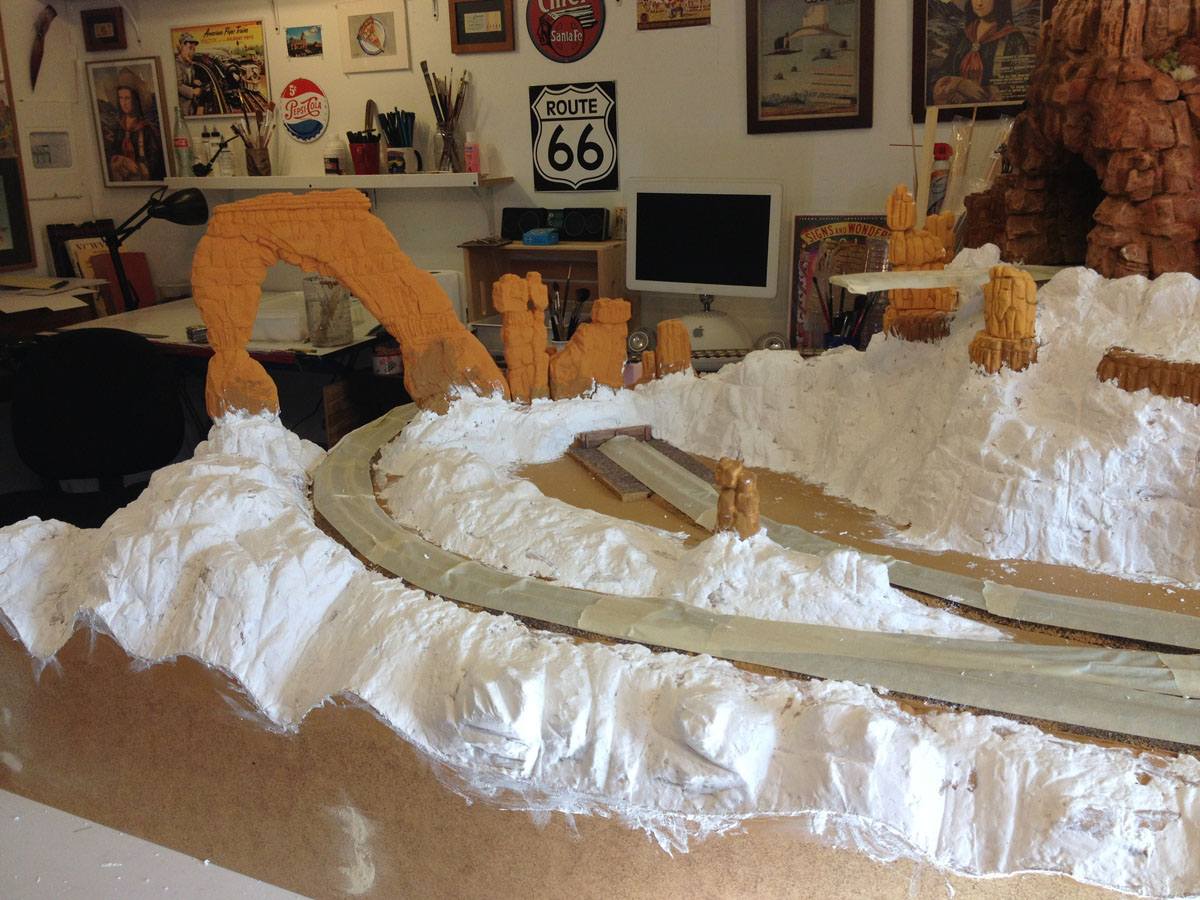 |
Letting the Sculptamold dry after it has been shaped and blended with the Balsa Foam carvings. |
 |
Sanding excess Sculptamold off of the profile board once it has dried. |
 |
Scenery painted with my standard base color. |
 |
Darkened with a spray of diluted India Ink. |
 |
The finished paint job. |
 |
Detail of McKennon Arch. |
Adding Ground Cover and Desert Plants
Once the rock work and scenery base was painted and allowed to dry it was time to add the ground cover and details. Once again I used real dirt and rocks collected in Sedona, AZ and near Moab, UT. For the greenery, I used a variety of products from Woodland Scenics and Scenic Express, plus my own, scratch built saguaro cacti. I made about fifteen cacti, using John Olson's tried and true method of carving them from balsa wood. These large cacti were intermixed with some smaller castings from Woodland Scenics. Small bushes are Woodland Scenics Extra Course Turf, and the clumps of grass and flowering plants are Silflor Tufts from Scenic Express. |
Sprinkling on real dirt and small rocks. |
 |
Wetting everything down with a spray of "wet" water: water with a few drops of liquid detergent added to break the surface tension. |
 |
Flooding everything with a generous amount of white glue diluted 1:1 with water. Diluted matte medium also works. |
 |
Gluing down larger rocks and boulders. |
 |
After all the rocks and dirt have been added. |
 |
I construct all of my cacti and trees with a small nail sticking out the bottom for planting. When everything is still wet, it's easy to push them right into the base. A dab of full strength white glue holds it in place. |
 |
Adding a Silflor Tuft to a dab of white glue. These tufts are an excellent product from Scenic Express and can produce very realistic looking scenery. I highly recommend them. |
 |
The Living Desert. |
Desert Critters
The Living Desert will be full of wildlife and here are a just few that have found homes there so far.
 |
This curious raven sits atop a cactus. He's made from acrylic modeling paste over a wire armature. |
 |
The coyote or desert wolf, carved from balsa wood. |
 |
And what would paradise be without a few serpents? This diamondback rattlesnake is a painted bit of solid core copper wire. |
What's Next?
Track through the Cactus Forest has been painted but still needs to be detailed with ballast and weeds. I'm waiting on some Woodland Scenics medium buff ballast via mail order.
 |
Trackside view of the completed area. I still need to balast the track and build a tailings trestle for the high-line track at right. |
 |
Adios for now! |
Subscribe to:
Posts (Atom)
